

What Succour Has CNG Brought? By Alabidun Shuaib AbdulRahman When President Bola Ahmed Tinubu announced the removal of the petrol subsidy on May 29, 2023, Nigerians were told that the decision, though painful, would eventually redirect public resources towards productive sectors, strengthen the economy and eliminate the distortions associated with the subsidy regime. What
What Succour Has CNG Brought? By Alabidun Shuaib AbdulRahman
When President Bola Ahmed Tinubu announced the removal of the petrol subsidy on May 29, 2023, Nigerians were told that the decision, though painful, would eventually redirect public resources towards productive sectors, strengthen the economy and eliminate the distortions associated with the subsidy regime. What followed, however, was an immediate and devastating increase in the cost of living, with transportation becoming one of the most difficult expenses for millions of Nigerians to manage.
For a country where millions of workers depend on commercial buses, taxis, motorcycles and tricycles to earn their daily living, the increase in petrol prices was not merely an adjustment in the energy market. It has affected virtually everything, including household incomes, access to education, healthcare, employment and small businesses. The price of transportation rose, food became more expensive because of distribution costs, and the purchasing power of ordinary Nigerians continued to deteriorate.
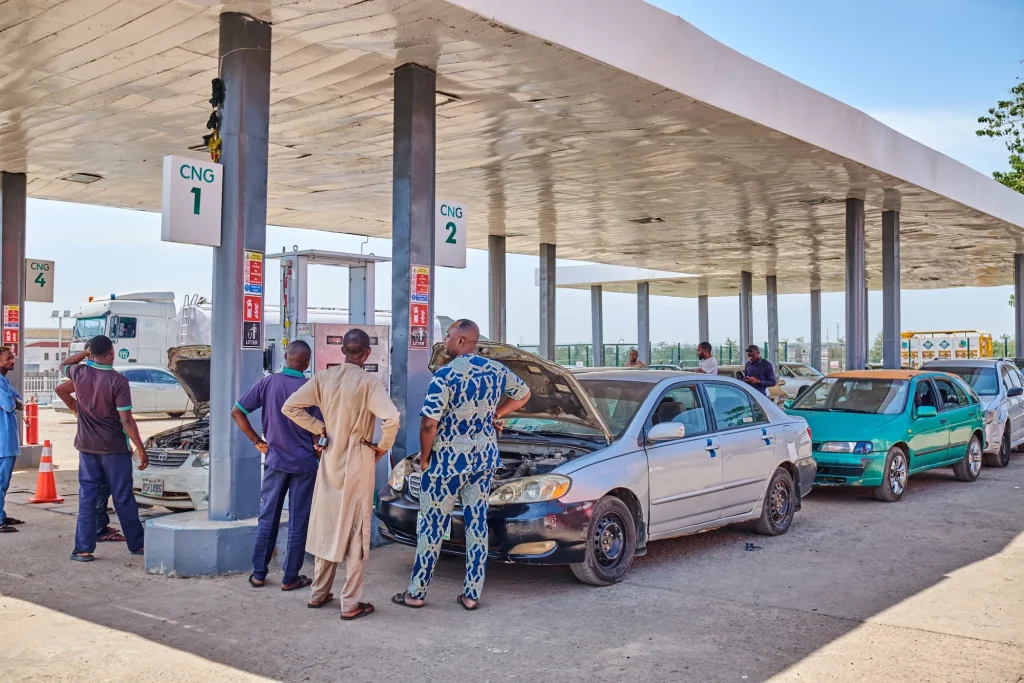
It was against this background that the Federal Government introduced Compressed Natural Gas, CNG as a major alternative to petrol-powered transportation through the Presidential CNG Initiative, with commercial rollout and initial asset deliveries commenced in October 2023. The initiative was presented as a practical intervention that would reduce the cost of operating vehicles, encourage investment in domestic gas utilisation, create employment and ultimately bring down transportation fares.
The idea was not misplaced. Nigeria is endowed with enormous natural gas resources, estimated at approximately 215 trillion cubic feet of proven reserves. There is little economic justification for a country with such resources to remain excessively vulnerable to the price of imported petroleum products and the volatility of international energy markets.
But nearly three years after the programme began, what succour has CNG actually brought to the Nigerian commuters and the populace? The answer cannot be determined by government announcements, commissioned facilities or the number of conversion kits distributed. It must be measured by the difference between what Nigerians paid for transportation before the intervention and what they pay today.
There is evidence that CNG has delivered benefits to some vehicle owners and selected public transport corridors. However, there is equally compelling evidence that the promised relief has not been felt by the majority.
The Presidential Initiative on CNG and Electric Vehicles has reported substantial progress. Its October 2026 impact report puts the number of vehicles converted at more than 140,000, with over 400 certified conversion centres established nationwide. It also reports more than $2.5bn in secured investment, over 5,880 jobs created and more than 8,000 technicians trained.
The initiative’s published station register, updated in October 2026, lists 105 CNG refuelling stations across 24 states and the Federal Capital Territory. This is an improvement from the earlier network of 61 operational stations reported in January 2026. The figures demonstrate expansion, but they also expose the distance between the country’s ambition and the infrastructure currently available.
At the maiden National CNG Summit in Abuja on November 4, 2026, the Executive Chairman of the Presidential Initiative on CNG and Electric Vehicles, Ahmad Ismael, disclosed that Nigeria had 105 operational stations, while another 127 were at various stages of completion. He said the government was working towards establishing 1,000 additional stations, comprising an earlier target of 500 and another 500 subsequently announced. These are encouraging projections, but a station under construction cannot serve a passenger today.
There is also a need to distinguish between CNG refuelling stations, gas processing facilities, mother stations, daughter stations and factories manufacturing conversion equipment or cylinders. They are different components of the value chain. A mother station compresses gas for distribution, while a daughter station receives compressed gas transported by specialised trucks. Neither should be described as a manufacturing factory.
As at the time of writing this column, there is no sufficiently detailed, consolidated and independently verifiable public inventory establishing the number of dedicated CNG manufacturing factories operating in Nigeria, their production capacities and their respective locations. The government must publish this information rather than allowing infrastructure announcements to blur the distinction between local manufacturing, gas compression, vehicle conversion and retail dispensing.
Geographical distribution is another concern. The official register demonstrates that CNG infrastructure is no longer restricted to Lagos and Abuja. Edo, Delta, Rivers, Lagos, Ogun, Oyo, Ondo, Ekiti, Osun, Enugu, Imo, Kaduna, Kano, Katsina, Sokoto, Kogi, Nasarawa, Kwara, Niger, Adamawa, Gombe and Borno are among the states represented in the published network, alongside the FCT. However, the remaining states are not adequately represented in the register.
This is not the sort of national spread required for a country with 36 states and the Federal Capital Territory. A resident of a state without a conveniently accessible refuelling facility cannot enjoy the economic advantage of CNG simply because a station has been commissioned in another geopolitical zone.
Even within states where stations exist, accessibility remains a practical challenge. A commercial driver who must travel several kilometres, queue for gas and return to his route has additional operational costs. The savings that appear attractive on paper can become less substantial when time, distance, availability and maintenance are considered.
Taken all in all, the most troubling aspect of the programme is the failure to establish a dependable relationship between cheaper fuel and cheaper transportation.
On October 17, 2026, TheCable published an investigation illustrating this issue through the experience of commercial transport operators in Lagos. At the time of its report, petrol sold for between N1,385 and N1,400 per litre in Ogba, while CNG sold for about N380 per standard cubic metre. Despite this considerable difference, a seven-seater commercial bus operating between Ogba and Ojota charged N500 per passenger, irrespective of whether it used petrol or CNG.
The investigation reported that a CNG-powered bus operator spent approximately N5,000 daily on gas, compared with about N30,000 spent by a petrol-powered operator. Yet passengers paid the same fare.
One driver, Olawale Aremu, explained that charging less would undermine the business of other drivers on the same route because passengers would naturally prefer the cheaper vehicle. This is a revealing admission. It shows that the problem is not simply the price of gas but the structure of commercial transportation, where fares are often determined collectively rather than by the actual operating expenses of individual vehicles. In other words, some of the economic benefits of CNG are being retained by operators instead of reaching the commuters whose suffering justified the intervention in the first place.
There are exceptions that demonstrate what is possible when government deliberately connects alternative energy with public transportation policy. In a statement issued on September 19, 2026, President Tinubu cited Borno, where alternative-energy buses were reportedly carrying passengers for between N50 and N100 on routes where commercial operators charged between N300 and N600.
He also reported that Kaduna’s 100 CNG-powered buses carried approximately 3.2 million passengers during their first year, saving commuters more than N3.5bn. In Oyo, the Lagos-Ibadan fare reportedly fell from about N8,000 to N3,200 during the initial deployment of CNG buses by Pacesetter Transport. Enugu reportedly reduced the Enugu-Nsukka fare from N2,500 to N1,500 through its CNG bus deployment.
These examples deserve recognition. They also establish an important point: CNG can reduce transportation costs when government takes responsibility for ensuring that the savings are transferred to passengers. But isolated achievements should not be mistaken for a nationwide transformation. Nigerians must be able to experience the benefits in their respective communities, not merely hear about them at government events.
The experience of other countries offers Nigeria a useful lesson. India, for instance, has demonstrated what sustained investment, regulatory coordination and deliberate expansion of gas distribution infrastructure can achieve. According to India’s Ministry of Petroleum and Natural Gas, the country had 9,096 CNG stations as of July 31, 2026. Its CNG infrastructure is supported by an extensive city gas distribution network, regulatory planning and the growing use of gas-powered public transport.
India’s experience did not emerge from the mere declaration of an alternative energy policy. It involved years of investment in pipelines, distribution networks, vehicle conversion, public transport fleets and private-sector participation. The Petroleum and Natural Gas Regulatory Board has also reported that India added 1,206 CNG stations during the 2024/2025 financial year, while its CNG vehicle fleet increased from 5.861 million in March 2023 to 8.195 million in March 2025.
The comparison is important. Nigeria cannot reasonably expect a transportation revolution with barely over 100 operational stations when a country such as India has developed thousands. Their population sizes and transport systems differ, but that does not diminish the lesson about infrastructure, continuity and policy execution.
What Nigeria needs is a programme that goes beyond vehicle conversion. The Federal Government must develop a national CNG distribution framework that connects gas-producing facilities to major commercial centres, industrial corridors, interstate highways and rural transportation networks. States should be encouraged to identify suitable locations, provide land, facilitate private investment and establish clear implementation targets.
More importantly, government must prioritise mass transportation. Rather than concentrating largely on individual vehicle conversions, there should be a deliberate expansion of affordable CNG-powered buses, tricycles and other public transport fleets. State transport authorities should operate these services on routes with demonstrable passenger demand and publish their fares, operational costs and passenger numbers.
There must also be a transparent fare-monitoring arrangement. Where public funds, subsidised conversion kits or government-supported gas infrastructure reduce operators’ expenses, a measurable portion of those savings should translate into lower passenger fares. Transport unions should be involved in negotiating practical fare arrangements without allowing collective pricing practices to erase the advantages of cheaper fuel.
Alabidun is a media practitioner and can be reached via alabidungoldenson@gmail.com













Leave a Comment
Your email address will not be published. Required fields are marked with *